

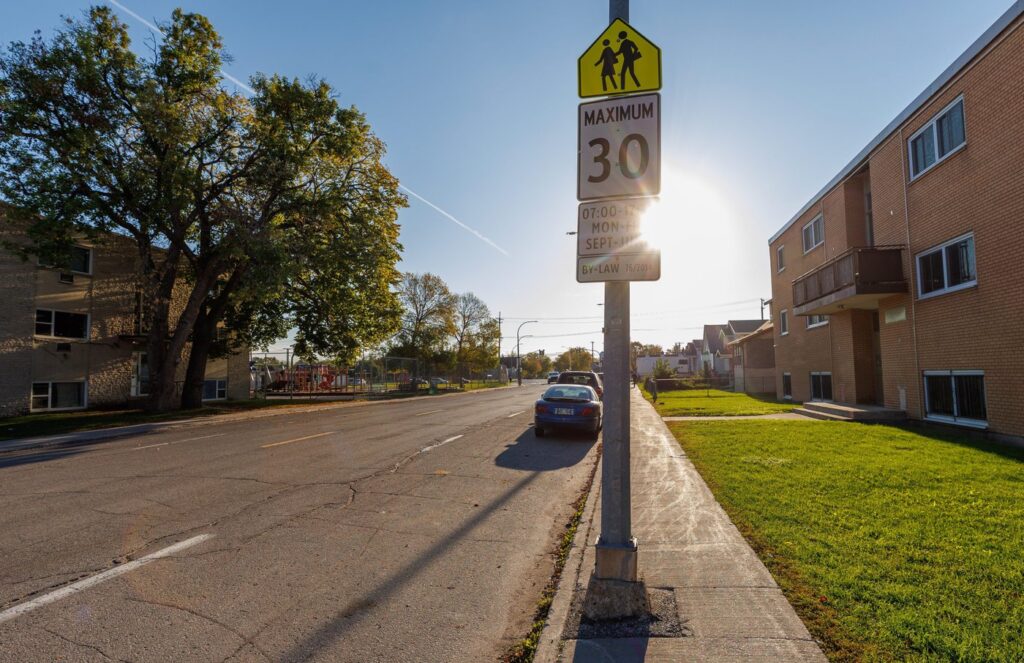
A pair of 30-kilometre-per-hour school zones known as speeding hot spots are getting safety upgrades this summer amid a citywide probe into posted speed limits.
Winnipeg school officials were recently briefed on hot spots for collisions and photo-radar tickets issued near elementary buildings between the months of September and June, when the maximum limit drops.
“There’s no cookie-cutter kind of solution, unfortunately,” said Denae Dorge, the city’s road safety outreach co-ordinator.
“You need to have lots of different tools in your toolbox and also, work with the families that attend your school.”
Arthur E. Wright Community School in the Maples (1520 Jefferson Ave.) and H.S. Paul School near St. Vital (160 Southglen Blvd.) will soon have traffic-calming curbs added to their toolboxes.
A slideshow viewed by the Free Press showed both are on the city’s list of top-10 schools with the highest rates of speeding tickets per hour of enforcement in 30 km/h zones.
Civil servants shared a data-packed presentation, along with new initiatives to reduce traffic and better protect pedestrians, at the Winnipeg School Division headquarters on March 10.
For trustee Ann Evangelista, who represents Ward 9 residents in the inner-city division, the statistics were a wakeup call.
“We could do more. We could do better, and we need to prioritize (school-zone improvements),” Evangelista said, noting she was shocked to learn there’s an average of 75 crashes on city streets every day. “This is an emergency.”
Four schools — Dakota Collegiate (661 Dakota St.), Victor Mager (81 Beliveau Rd.), Kelvin High School (155 Kingsway) and St. Emile School (552 St. Anne’s Rd.) — are located within 200 metres of one of the city’s top-10 problematic intersections, based on network screening data.
The transportation unit ranks its priorities based on collision history, road characteristics and other issues, compared to similar locations.
The Winnipeg School Division submitted a proposal to city hall to implement 24-7, year-round reduced-school speed zones in September.
“Our goal of reducing accidents and fatalities should not be limited to 10 months,” said Evangelista, who chairs the board’s environmental advisory committee.
While she’s personally in favour of lowering limits in all residential neighbourhoods, she said there has been no consensus among or within other boards.
Members of the Manitoba School Boards Association did, however, pass a resolution at their winter convention to lobby governments to formally consult them in matters of traffic safety in and around schools.
Dorge said her unit is keen to work more closely with schools to learn about particularly troublesome areas and brainstorm immediate and permanent measures.
“We’re looking for more nimble ways that we can respond to safety concerns that are quick to install and quite a bit more affordable than a permanent installation,” she said.
Nine schools are involved in a new pilot of in-street crosswalk signage — a traffic-calming measure that’s long been used outside the Perimeter Highway — that began in November.
A total of $4,500 was budgeted to test out high-visibility signage placed in the middle of roads between 8 a.m. and 4 p.m. on school days.
The new addition outside Frontenac School (866 Autumnwood Dr.) immediately elicited positive feedback from student patrollers, families and neighbours in St. Boniface.
Principal Shauna Archer said it’s made “a huge difference” in reducing speeds on the block because drivers can’t ignore the bright yellow post, and they’re forced to navigate around it.
A designated stop-drop-go zone and regular communication with families are all part of the facility’s ongoing efforts to reduce congestion, Archer said.
“It’s important that we’re having these conversations because it is a really essential piece of the puzzle of school,” she said.
Dorge said the pilot has, largely, been seen as a success among participants, but several signs have gone missing.
Along with new signage, her team is regularly reviewing parking zones and lighting and, as of last year, installing traffic-calming curbs, to improve road safety in school zones, she said.
The March 10 slideshow indicates her team has “high-level plans” to analyze all of the top 10 ticket hot spots in school zones over the summer.




