


As the twisting kaleidoscope that moves us all in turn, this week’s book review sits at the intersection of a meaningful conversation, a music column and an anniversary. It feels wonderfully timely and appropriate to allow them to orbit one another in these pages.
A recent conversation with a friend and colleague ascended into a very real, often denied, often overlooked and quite dynamic idea. A walking contradiction does not necessarily mean an absence of integrity—sometimes it means a person has lived deeply enough to contain more than one truth at the same time. Also, this week’s Northern Reflections column features the band A Perfect Circle fronted by Maynard James Keenan. This week is the 26th anniversary of their first album, Mer de Noms.
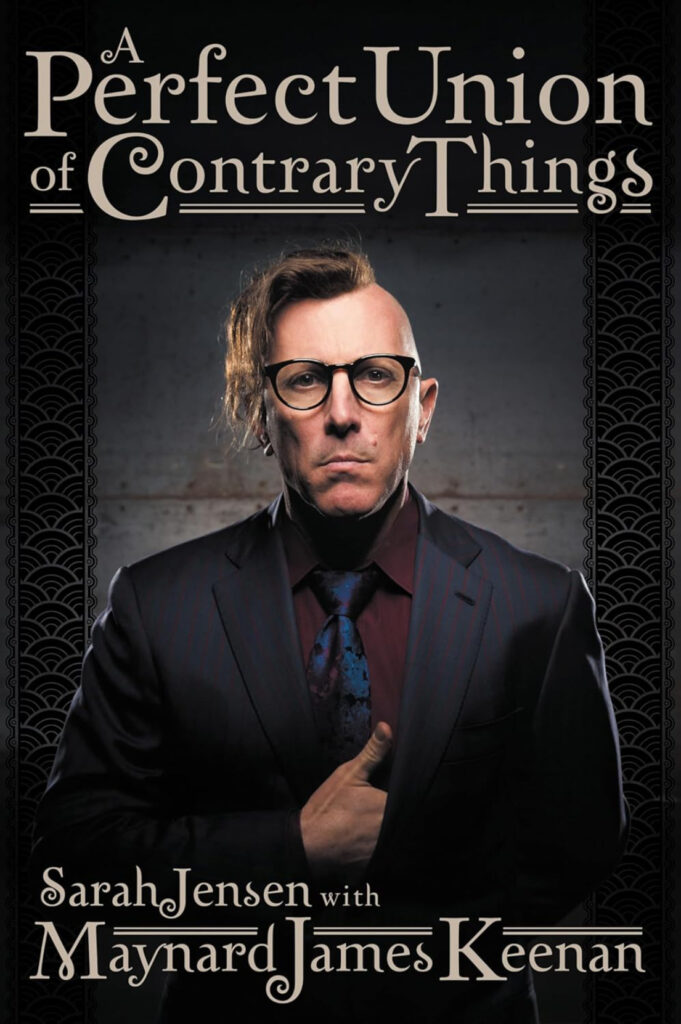
Keenan is an art-conjuring sacred clown who lives nestled in the depths of art, who embodies internal opposing forces that never cancel each other out and who makes wine from his vineyards on the side.
Co-authored by Keenan and friend Sarah Jensen, A Perfect Union of Contrary Things shares his journey through life. It carries the heart of a deep dive into thoughtful vantage points of a talented and complex man, told alongside memories. It doesn’t feel like an autobiography. Beginning with a childhood of imagination but instability, this book follows his winding walk through time in the military, family, career, art, creation of his wine business (Caduceus Vineyard in Arizona), and gathered wisdom along the way.
What stands out like white-hot light is the difference between the trajectories of Maynard and the many (perhaps too many) musicians who inhabit the rockstar role over recent decades. Extremely focused, sarcastic, driven by work and discipline and extremely observant, his story feels more like that of a Renaissance man with a million interests and passions than a scattered individual. Be it martial arts, making wine, visual art schooling, music or intelligently biting commentary of the superficial and shallow, his story never gets boring.
I am reminded that some of the truest Renaissance men and women also fill the shoes of the jester, which is why those who appreciate authenticity also acknowledge them as kings and queens.
Most recognizable from bands such as Tool, A Perfect Circle, and Puscifer, performances with fellow musicians (such as Rage Against the Machine, Tori Amos, among others), and cameos in movies such as Sleeping Dogs Lie (I still can’t pry armadillos and corn nuts from my memory).
There is a conscious intention in his pursuits.
Following a tragedy involving (and long-lasting health impacts upon) his mother, it is crystal clear that what shaped Maynard (and many of us who share our world) are sometimes stories we rarely share. Significant journeys through anger, understanding and gratitude (best expressed by Keenan himself) can be felt respectively in A Perfect Circle’s “Judith”, as well as Tool’s “Wings for Marie Part One” and “10,000 Days Wings Two” reveal depth, the link between growth and art and how discipline and embracing of contradictions instead of simple, surface identities can heal. Art is healing and a teacher, but it makes one wonder what came first—the experience that births the art or the art that guides our experiences.
It’s an interesting, poignant, reflective, and thought-provoking read.
Part teacher, part comedian and part Joker, he reminds us of something very important.
Contradictions grow from our experiences are fractal, even multidimensional.
It’s only when we allow our ideas and individual identities (and our perspective towards others) to be simplistic, reductionist or essentialist that we fall into an interesting trap where we fail to experience ourselves or truly experience and appreciate others and what grows, develops, and gets created.
Be it ideology or being so certain that we know what’s best for others and who they are, the surface appears so simple.
But dig deep, descend, and enjoy the scenery.
What is often mistaken (even critiqued as mere hypocrisy or mutual exclusivity) is best answered by hermetic teachings. When we look at the nature of ideas, there are no opposites. Just different degrees of the same thing.
Look at your thermostat. Where exactly does heat end and cold begin?
Are they truly opposites?
Artists like Maynard know for sure, and at some threshold and depth, we do too.
Backbeat, 304 pp, $25.99
Robert Horton is an educator, author, orator and linguist. He is a member of Rainy River First Nations.




