



The walls used to speak to me with a buzz of contrarian rebels. While making the city home for several years, the Madhouse in Thunder Bay made for an amazing place to reflect and write.
However, it was not the ebb and flow of conversation nor the lively debate filling the room that made it special. It was the art—rebels gazed out from the acrylics on each wall of the Madhouse.
Gadflies. Rebels. Contrarians. Those who walked to the beat of their own drum. Trailblazers. Warriors. Those who unapologetically thought for themselves. Those who spoke truth to power and taught others how to think by example rather than telling them what to think. Those who didn’t fold their unique perspective and individual pulse beneath the expected, accepted, or status quo. Those who matched the clarity of their voice, pen, or paintbrush to the call of their soul.
Hunter S. Thompson. Salvador Dalí. Ernest Hemingway. Frida Kahlo. Beyond their years and ahead of their time, they proudly coloured outside the lines and did so with grace.
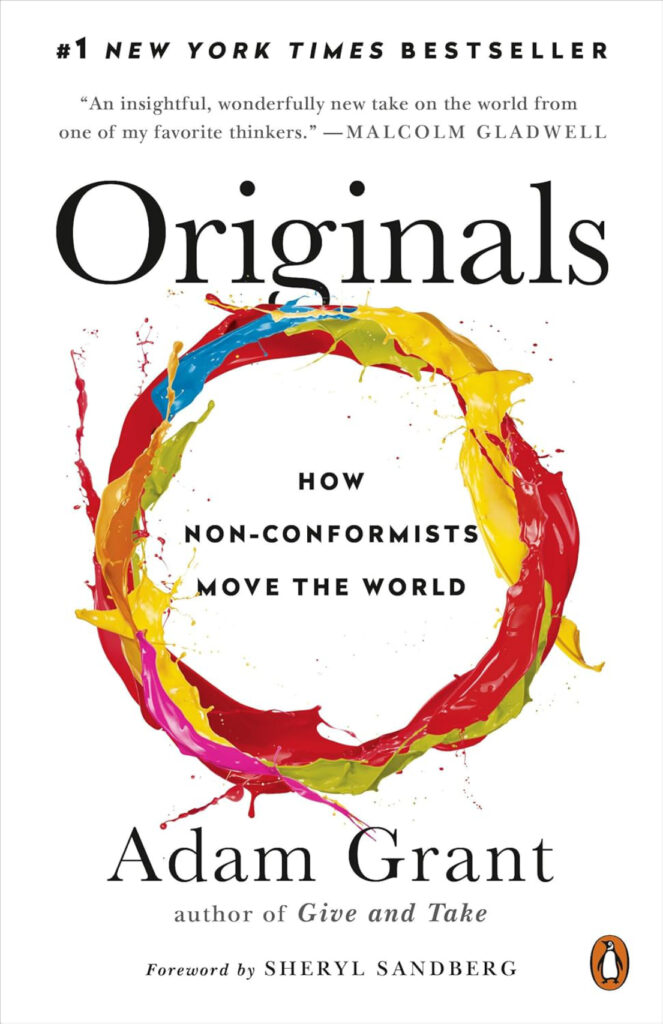
Adam Grant, author of Originals: How Non-Conformists Move the World, shares that originals and rebels increasingly influence the life and progress of our civilization, cultures, direction, and the gradual reveal of what is possible.
Where would we be without those who dream, who think outside the box, who reach for a world we have yet to see?
However, Grant has a caveat. He shares that being an original in this sense is not necessarily a personality trait. It can be learned and practiced as a set of behaviours and strategies.
It begins with questioning defaults and improving the status quo.
It is not done recklessly, but by managing risk in a strategic way.
Above all, originality is not necessarily innate talent, but the choice to be creative and to create change by implementing one’s habits (such as idea generation, timing, and coalition-building). Originality is learnable and arises from how you think and act, not necessarily who you are.
There are a number of insights that Grant reveals that run against what is often accepted as common knowledge:
- Originality is developed through habits and the questioning of how things have always been done. It’s not that creative or change-driven people are necessarily risk-takers or geniuses, but that they are willing to think outside the box and challenge norms. Moderate procrastination can boost creativity as well. Letting ideas incubate leads to original thinking without the fog of rushing or waiting too long.
- Originality occurs when risk is managed rather than embraced blindly, such as when one is cautious in one domain while taking risks in another (essentially hedging between maintaining stability while pursuing ideas).
- Originality continues to emerge when the production of many ideas increases the odds of generating great ones.
- Originality has its first sparks when progress comes from challenging norms—when we ask, “why does this exist?” or “what if we did the opposite?”
- Originality is helped along by timing. Being first isn’t always best, as early movers often fail. Those who move moderately early have the benefit of learning from others’ mistakes.
It is often the underdog. Those without authority (or outside leadership) are often more persuasive advocates for new ideas because they face less pressure to conform.
It can be a team effort. Building alliances and gaining support is critical, as originals succeed by strategically recruiting others.
Persuasion honours balance. It is key to acknowledge weaknesses in one’s argument, as this increases credibility more than presenting only strengths.
It holds the heart of a rebel. Innovation often comes from cultures that tolerate dissent. Organizations and initiatives that encourage constructive disagreement regularly outperform those that prioritize harmony.
It is generational and always in progress. When parenting encourages values over rules, independent thinking is fostered. Children shaped in these environments behave better and think more creatively.
Also, fear is part of the road, but it shouldn’t define it. Doubting ideas (while still believing in yourself) leads to better refinement. In the face of uncertainty, originals still act.
The bottom line: originality is less about a bold personality. It leans more toward disciplined thinking, strategic risk-taking, and environments that support questioning and accepted dissent.
If there is one constant element in our world, it is change. Grant gives us a harbour in the tempest.
Prime Minister Pierre Trudeau placed importance on approaches that were open to experiment and innovate, but not to apply old doctrinaire solutions to new problems.
He was correct.
Perhaps our shared old maps of yesterday severely limit how successfully we can navigate the changed landscapes of today.
Perhaps a key to moving our world forward in the best ways possible may be stepping into the shoes of a rebel.
Into the shoes of Thompson.
Of Dali.
Of Hemingway.
Of Kahlo.
Into the shoes of the rebel, the contrarian, the gadfly.
And never without mindful grace.
Given the by-election results this week, Prime Minister Mark Carney’s Value(s): Building a Better World For All will be reviewed next Wednesday.
Viking, 336 pp., $39.99
Robert Horton is an educator, author, orator and linguist. He is a member of Rainy River First Nations.




