


Ponder this for a moment.
When we observe the world, we encounter remarkable things—the beauty of a rainbow, the awe of a solar eclipse, the sheer chaos of a honey badger. Yet, across the animal kingdom, other creatures experience reality in ways that differ radically from our own.
Humans perceive only a narrow slice of the electromagnetic spectrum. Honeybees detect ultraviolet patterns on flowers invisible to us. Pit vipers sense infrared heat through specialized facial pits. Bats and dolphins construct detailed spatial awareness through echolocation. Sharks detect faint electrical signals from prey. Birds and sea turtles navigate using Earth’s magnetic field. Mantis shrimp possess up to sixteen types of photoreceptors, far beyond our three, suggesting a richness of colour we cannot imagine. Other species navigate through chemical gradients, vibrations, or pressure changes that remain entirely outside human awareness.
This diversity of perception leads to a humbling realization: human experience is not the standard by which reality is measured. Each species inhabits its own perceptual world.
From here, a deeper question emerges—how do we know that what we perceive is an accurate reflection of reality at all?
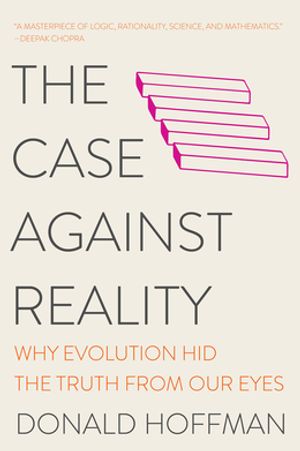
In The Case Against Reality: Why Evolution Hid the Truth from Our Eyes, Donald Hoffman, a cognitive scientist specializing in perception and consciousness, argues that we don’t.
His central claim is that evolution does not reward accurate perception of reality. Instead, natural selection favours perceptions that enhance survival and reproduction. Seeing the truth of the world, in full detail, is not necessary—only seeing enough to act effectively.
Over time, this leads to a striking conclusion: our perceptions are not designed to reveal reality as it is, but to present a simplified, useful interface.
Hoffman compares this to a computer desktop. The icons on a screen are not the underlying files or circuits—they are convenient symbols that allow us to interact with something far more complex. Likewise, what we see, hear, and feel may be a species-specific interface rather than a direct window into the structure of the world.
There is still a real world. But we do not experience it directly. What we encounter is a constructed representation—an internal model shaped by evolutionary pressures.
This line of thinking carries significant implications.
First, objects may not exist as we perceive them. What we experience as “out there” is, in part, a reconstruction generated “in here.” Our senses gather signals, and the brain interprets them into a coherent, usable form.
Second, it raises the possibility—still highly debated—that consciousness may be more fundamental than physical objects. Hoffman explores this idea, suggesting that what we call matter could emerge from deeper structures of conscious interaction. This remains speculative and is not widely accepted within mainstream science, but it opens an intriguing philosophical direction.
Third, it reframes the role of science. Scientific models remain extraordinarily powerful—they predict, explain, and enable technological progress with precision. However, under Hoffman’s view, these models may describe the structure of our interface rather than the ultimate nature of reality itself.
At the same time, this perspective invites important challenges.
If our perceptions are fundamentally unreliable, on what basis can we trust any theory, including Hoffman’s? And if science consistently produces reliable, repeatable results, does that not suggest that at least some aspects of our perception align with real structures in the world? These tensions do not invalidate Hoffman’s ideas, but they highlight the need for careful consideration.
The Case Against Reality is not a light read. It requires patience, as each concept builds on the last, often forcing the reader to reconsider assumptions that feel deeply ingrained. At times, it feels like assembling a structure where each layer depends on the stability of the previous one. But once the pieces begin to align, the argument becomes clear and compelling.
What emerges is not a rejection of science, but a clearer sense of its reach and its limits. Our tools have made the universe intelligible in ways that would have seemed impossible centuries ago. Yet they may still operate within a framework shaped by human perception.
Ultimately, the book points toward a humbling conclusion: we are not the measure of all things.
Reality—whatever its true nature—may be far more complex, far more layered, and far less accessible than our everyday experience suggests. Our experience and vantage point is a way—not the way—as we continue to reach, question, and grow toward a deeper understanding of what may remain, in part, beyond us.
W. W. Norton, 280 pp., $18.95
Robert Horton is an educator, author, orator, and linguist. He is a member of Rainy River First Nations.




