

WINGHAM – During the Wingham and Area Historical Society’s first meeting of the year, Brent Bowyer described how one Amish family turns a small farm pond into their year-long refrigeration system each winter.
Bowyer has spent nearly four decades as a neighbour and customer of the St. Helens Amish—buying bread, hiring them for repairs and farm work—and it was that long, informal relationship that finally earned him an invitation to stand on the pond bank with his son and watch them put their ice-harvesting tradition into motion.
Bowyer described the recent visit he and his son made to a farm outside St. Helens to learn more. On a slushy January morning, the only hum on this Amish farm comes from a gas-powered generator at the edge of a pond. A buzz saw slices the six-inch-thick ice into neat 18-inch squares. Young men in plain coats guide the blocks with pitchforks onto a powered conveyor, where they’re hoisted onto horse-drawn sleighs and hauled up the hill to a heavily insulated ice house — a low-tech cold storage system the family counts on to keep milk and produce chilled well into December.
Visiting on January 14, Bowyer said he found the ice “only about six inches thick,” which was ideal because “the way they cut it with new technology; they had the generator sitting at the edge of the pond, and they had a buzz saw… that can also cut ice.”
By the time he arrived, “the entire pond… they had it already cut up with their buzz saw… making blocks of ice that were about 18 inch square.” A crew of “seven or eight young guys with pitchforks” guided the blocks onto a powered conveyor belt, lifting them to horse-drawn sleighs, where each piece weighed “30, 40, 45 pounds, something like that.”
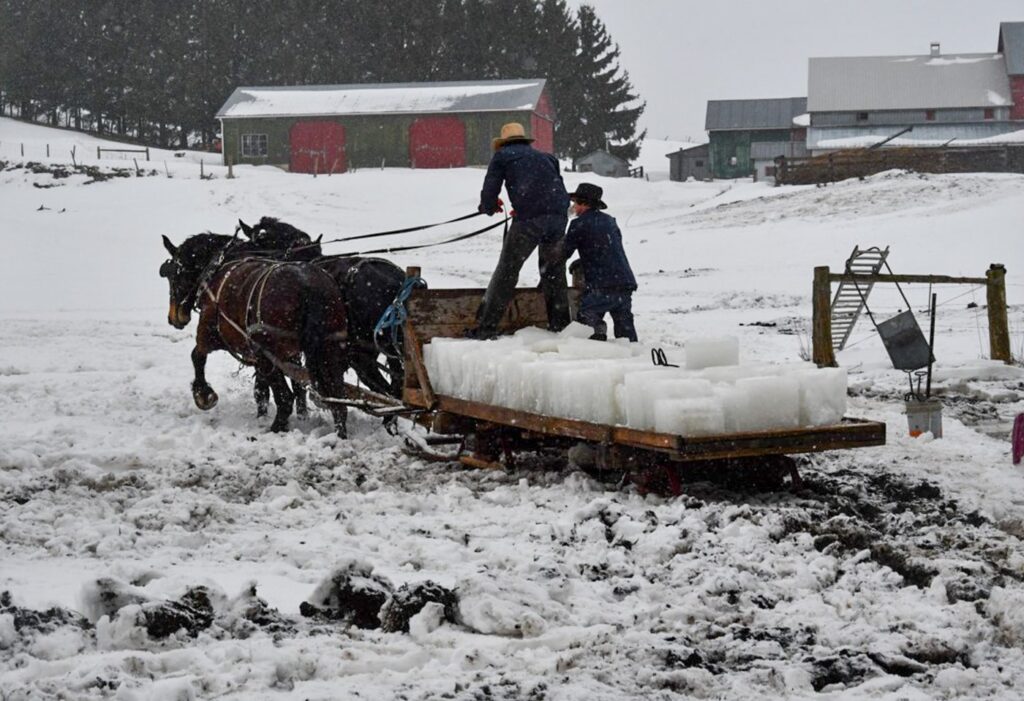
Teams of Belgian horses then dragged the sleighs up a hill to a compact, heavily insulated ice house—”like a small garden shed” with styrofoam “about 16 inches thick on the walls of the Ice House and on the ceiling”—where older men stacked the blocks to keep milk and vegetables cold “from now till the end of this year.
Bowyer emphasized the sheer exertion and teamwork behind the harvest. He watched “seven or eight young guys with pitchforks” working nonstop to “separate and guide the chunks of ice” onto the moving conveyor, sometimes lifting blocks that “might be 70 or 80 pounds” when two pieces froze together.
Down below, teams of Belgian work horses “were really… working hard to get it up that hill because the sleigh was sinking” in the wet, slushy snow. At the top, “a couple old guys that were 50 or 60 or 70 up at the Ice House” took over, lifting and stacking each block by hand. By day’s end, Brent said, “I’m sure they were all tired by the end of the day,” but the work unfolded as a coordinated community effort, from young men on the ice to elders in the ice house
For Bowyer, the scene on the pond summed up the balance the Amish strike between old ways and new realities. A gas-powered generator and buzz saw did the cutting, but it was horse-drawn sleighs, ice tongs and sheer muscle that moved the blocks up the hill, with older men stacking them in an ice house wrapped in 16 inches of insulation. In an era of chest freezers and digital thermostats, the St. Helens Amish are still banking winter cold for the year ahead—leaning on faith, hard work and a tight-knit community rather than a hydro bill.




