


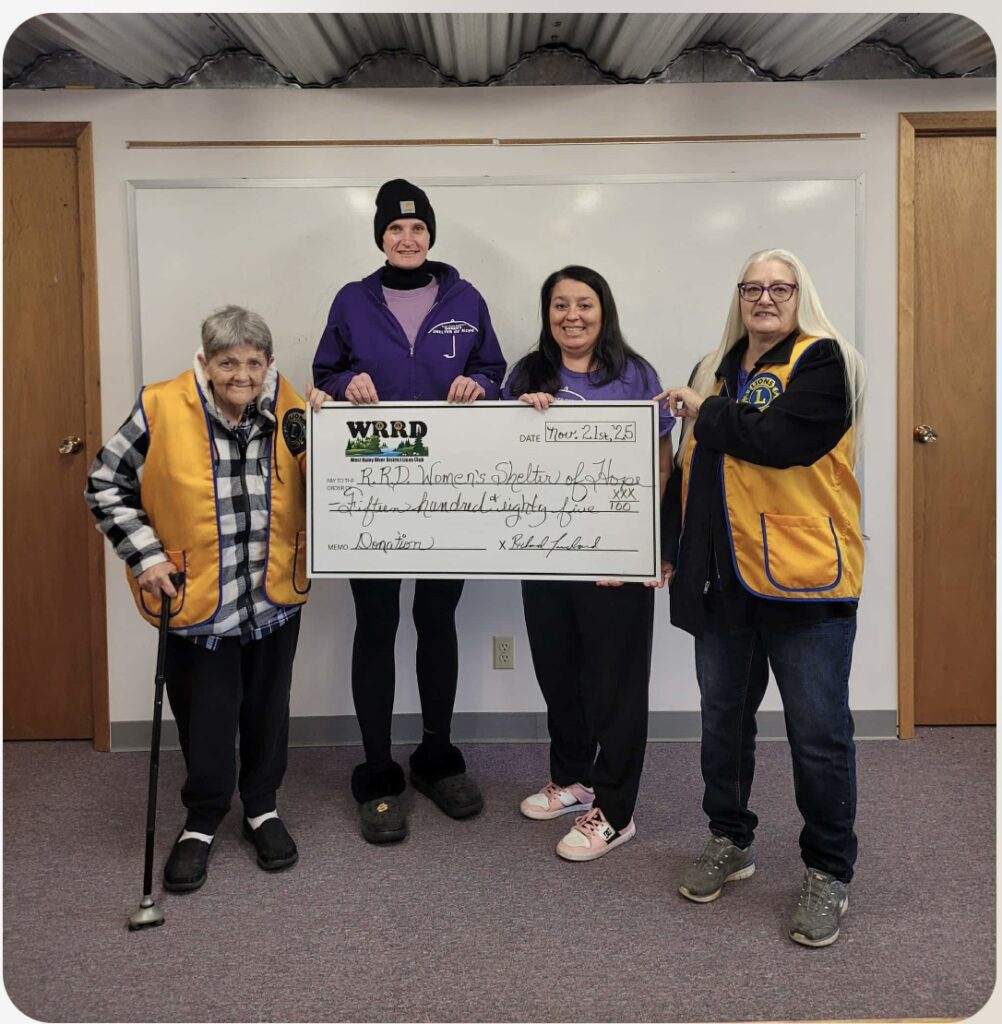
The Rainy River District Women’s Shelter of Hope is extremely grateful for a generous donation given to the shelter from the West Rainy River District (WRRD) Lions Club that will help them in their continuing mission to help women in need.
The Rainy River District Women’s Shelter of Hope is a safe centre where women and their children can go to when they are fleeing a domestic violent situation. Situations are not always physical but also mental, emotional, financial and spiritual.
The donation from the WRRD Lion’s Club totalled $1,585 and came as a result of their annual Hunter’s Supper that was held on November 8, 2025.
Program manager Sue Hanson shared that the money from the donation will go towards some of the common items that are most in need for those who make use of the Shelter’s services, along with some other special items.
“The donation will go towards] buying extra food for Christmas and purchasing all women and children a Christmas gift, as well as transportation costs, haircuts, client support and, often, personal care items” Hanson said.
“The everyday things we take for granted.”
The shelter does accept financial donations, personal items such as shampoo, conditioner, soap, comfort items such as warm cozy blankets that they can take home when they leave. One of the most important thing she would like women to know about the Women’s Shelter is that “We are here, for any women needing help. There are so many women that aren’t aware this service is available.”
The Rainy River District Women’s Shelter of Hope serves the entire Rainy River District plus the 10 local First Nations communities. There is a Fort Frances office located at 436 Scott Street, and can be reached at 274-1172. The phone number for the Shelter of Hope in Atikokan is 597-2868.
The Shelter is also available to women of all ages. Women age 16 are considered adults and can go to the shelter, and staff have helped women into their 70’s who have come to the shelter for the first time, often coming to the decision they’ve lived an abusive life for long enough and refusing to tolerate it any more.
The shelter is a big house with a true homelike atmosphere, where bare feet and pajamas are totally accepted. It provides food, over the counter meds, plus a limited amount of clothing is available for those in need.
“The Atikokan pharmacists are very helpful filling perceptions for women/children staying at the shelter,” Hanson said.
“The dedicated, caring support workers want women/ and their children, to know that when they arrive, staff look after their immediate situations, they don’t have to be worried about tomorrow and their personal needs will be met. Seldom is there not a place available at the Atikokan shelter and if there isn’t a spot a transfer can be made to a sister centre.”
Women/children attending the shelter can stay for up to six weeks, and there is in-house counselling available from Monday to Friday, as well as additional supports like AA meetings.
When ready to leave the shelter, supports are given to help women move out successfully. These supports can include transitional housing, referrals and other necessities that can be arranged for women once they leave, allowing them to have a better, safer life once they are on their own. Hanson referred to it as, “What am I going to do when I grow up?”
And the shelter will definitely do all they can to help, ensuring women that they do feel grown up and in control of their lives once they leave the shelter.
Sue said that there are women that do come to the shelter more than once, and absolutely no judgment is made. The time spent at the shelter gives women time to think and hopefully leave with a clear head. Skills and living tools are also taught while they are there to help women gain confidence. The shelter also provides a safe location for them and their children, with the added security of knowing there’s a safe place to go if there is a next time.
Hanson said the Shelter works as well as it does because of help and support from other local organizations.
“We have very strong networking agencies throughout the district, we make it work,” she said.
Agencies such as Canadian Mental Health, Health Unit, Friendship Centre, Victim Services and Salvation Army all work hand in hand providing women the best care, support and education possible.
There are times when women may not have transportation when needing to get to the shelter. Transportation will always be arranged, sometimes by taxi. The shelter will arrange to pay for gas, often arrangements can be made for a local gas station to fill up a gas tank. If it’s an emergency Police will be called in order for the officers to provide safe transport to the shelter.
There is a 24 hour crisis line available toll-free at 1-800-465-3348, and Hanson explained that all calls are anonymous. Callers sometimes aren’t even looking for access to the shelter, instead reaching out to hear a supportive voice.
“All calls are anonymous,” Hanson said.
“There is no call display, we won’t be offended if women hang up, you never have to give your name, we are here 24-7 and there’s absolutely no commitment”.
There are specific rules women must follow while staying at the shelter, such as since it’s a dry shelter, no drugs or alcohol are allowed. Aggressive behaviour will not be accepted and people will be kicked out if they display any inappropriate behaviour. Although communal living can be difficult, everyone tries their best to make for a secure and safe place to be.
Sue shared that although her job is not easy, it’s definitely a rewarding job. The “high” she gets from her time spent at the centre is definitely in seeing women change their lives. She said she sees people at their lowest with bare feet and pajamas and broken spirits because they have walked on eggshells for so long eventually leave the shelter, heads held high, and confident that they have their own places to live and financial means, able to go and face the world and truly like themselves.
“We are here for any women needing a place to go,” Hanson said.
“No one has to live in fear. Call 807-597-2868 or the 24-7 hour crisis hotline at 1-800-465-3348 if assistance is needed.”




