


To this day, it’s not uncommon for my friends and I to debate in my living room until sunrise about what’s happening with the Rogues Gallery in Gotham, as if it’s a real city.
For many of us, comics and science fiction are more than fun stories. They’re modern myths —entertaining tales that sneak in some of the hardest questions humans have ever asked:
“What is justice?”
“Do we have free will?”
“How much freedom should we trade for safety?”
What even counts as “real”?
By looking at a few examples, we can see how philosophy hides in plain sight in our favourite stories.
Philosophy Beyond the Page
Philosophy isn’t just dusty books or impossible riddles.
At its heart, it’s about sharpening how we think—asking better questions, spotting weak arguments, weighing tough choices, and explaining our reasoning clearly.
These skills matter everywhere. A lawyer arguing in court, a teacher guiding students, a doctor making an ethical call, or a government lawmaker or policymaker balancing security with liberty all rely on philosophy whether they name it or not. Judges, engineers, entrepreneurs, and even designers use the same habits of reflection: clarifying assumptions, testing consequences, and justifying decisions.
Without this kind of thinking, we risk being blind to our own choices.
As the Oracle tells Neo in The Matrix: “We can’t see past the choices we don’t understand.”
Philosophy helps us see them.
And comics and science fiction provide the perfect stage to make these abstract ideas concrete.
The late Carl Sagan once said, “we make our world significant by the courage of our questions and the depth of our answers.”
Batman and the Joker: Duty vs. Consequences
If Batman ended the Joker’s life to protect lives in the future, would that be right?
A results-based view (utilitrianism) says yes: if it saves more lives overall, it’s justified. A principle-based view (deontology) says no: ending life is always wrong, no matter the outcome.
This clash — consequences versus unbreakable rules — drives some of the oldest philosophical debates, played out every time Batman refuses to cross his line.
Skynet and the Rights of AI
In Terminator, if an AI becomes fully self-aware, does it deserve rights? Shut it down — have you trampled on its right to life, or just unplugged a machine?
What once sounded like fiction now creeps into real debates about robots and AI. At its heart is a question as old as philosophy itself: what does it mean to be alive and conscious?
Jedi Prophecy: Free Will or Fate?
When the Jedi Council predicts Anakin’s destiny, are they glimpsing an unchangeable future — or creating it by their very prediction?
This tension between fate (determinism) and free will has haunted philosophy for centuries, and Star Wars renders it with operatic tragedy.
Professor X and Jean Grey: Ends vs. Means
In X-Men, Professor X sometimes tampers with Jean Grey’s memories to contain the Phoenix Force. Is this protection — or a violation of her freedom?
The question cuts deeper: do noble ends ever justify crossing personal boundaries? Even with the best intentions, is it right to steal someone’s ability to choose?
The Matrix and Hyperreality
Here things get especially dizzying. The Matrix asks: could a fake world be so convincing it feels more real than reality itself?
This idea comes from philosopher Jean Baudrillard (Simulacra and Simulation), who argued that copies sometimes replace the original in our minds. A digital “copy” of reality might end up feeling truer than the messy, flawed original.
So if the illusion feels better than reality, which should we choose?
The Oracle and Neo: Choice and Self-Knowledge
When the Oracle tells Neo to “Know thyself” but refuses to confirm if he’s the One, she leaves the revelation (and certain decisions) to him.
The lesson: sometimes the challenge isn’t fate, prophecy, or reassurance – but recognizing the choices others must make for themselves and revelations must come to them.
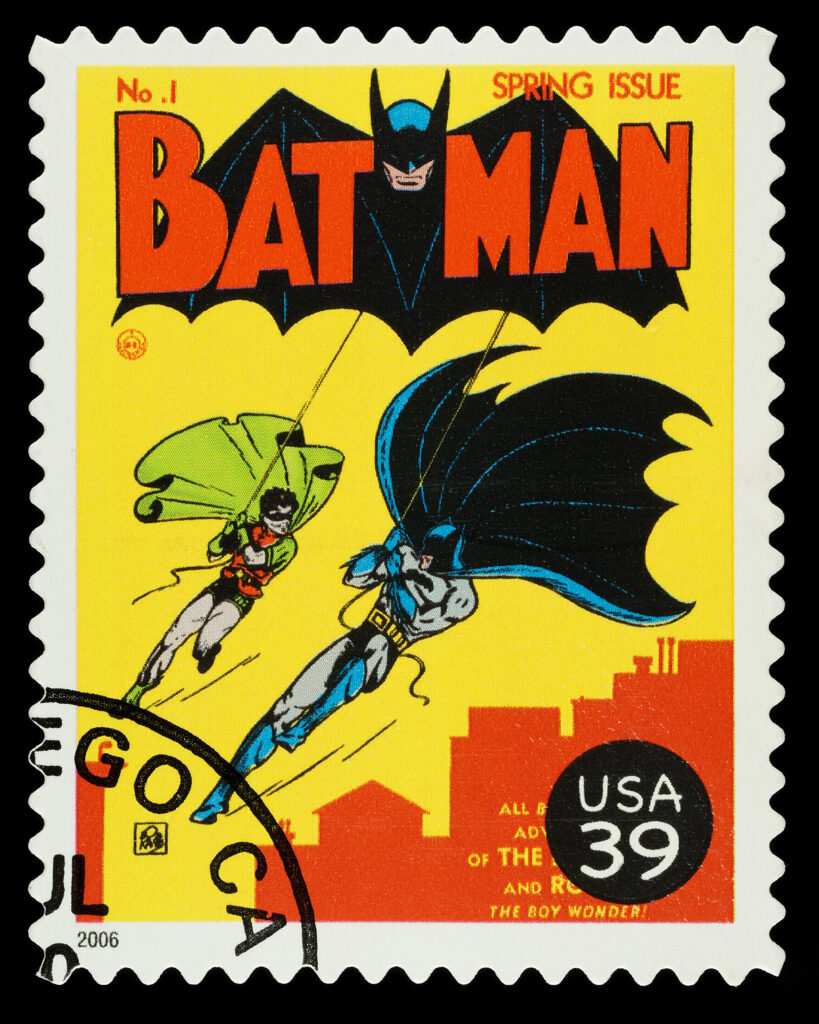
A 2006 U.S. stamp featured Batman and Robin, the Dynamic Duo, as part of a line of
stamps celebrating DC Comics superheroes. – Getty Images / andylid photo
Gotham Under Surveillance: Liberty vs. Security
In The Dark Knight, Batman spies on all of Gotham to catch the Joker. It works — but at what cost?
Thomas Hobbes might cheer this move: he believed safety mattered more than freedom. John Locke would protest: liberty is too precious to trade away.
That same debate continues today in arguments over surveillance, privacy, and national security.
Conclusion: Philosophy in Disguise
From Batman’s moral code to Neo’s awakening, from Skynet’s self-awareness to the illusions of The Matrix, comics and sci-fi give us more than entertainment. They provide a stage to wrestle with the biggest questions we face.
They let us debate justice, freedom, and reality itself—not in a lecture hall, but in stories that thrill us. And the sharpened habits of philosophy—clarity, argument, reflection—equip us for every arena of life, whether we’re drafting laws, treating patients, building technologies, or simply navigating everyday choices.
As Batman and the Joker remind us, justice will always be imperfect, and the struggle between right and wrong will never end. But that struggle is exactly what it means to be human.
And maybe, in another world, Morpheus might lead Neo not to a kitchen but to the Oracle at Delphi, beneath Apollo’s temple. With newfound awareness, Neo could ask:
“What are you saying? That I can dodge illusions, shadows, and doubt?”
Morpheus would smile: “I’m saying when you’re ready, you won’t have to.”
– Robert Horton is an educator, author, orator, and linguist. He is a member of Rainy River First Nations.




