



At a rate of 50-70 meteors per hour, and with the pleasant weather of the summer months, the Perseid meteor shower is a popular viewing for amateur and expert astronomers alike. The Perseids peak in activity on the 12th and the 13th of August this year, and are best viewed after the sun sets and before the moon rises in the early night hours, facing south.
Although the peak of the meteor shower has technically passed, Jenna Hinds, Executive Director for the Royal Canadian Astronomical Society, said the Perseids run four weeks long, so there should still be plenty of viewing opportunities for those interested.
“The Perseids are popular for two reasons,” said Hinds. “One is that there’s a high rate of meteors. So, you get a lot of meteors per hour in the Perseids, and it’s consistently good, which is nice. You get, consistently, quite a few meteors per hour. The number of meteors per hour is between 50 to 70 per hour, so almost one a minute in a dark sky.”
While it isn’t the best meteor shower the Earth has to offer, it tends to be one people in the Northern Hemisphere prefer because of the pleasant summer weather.
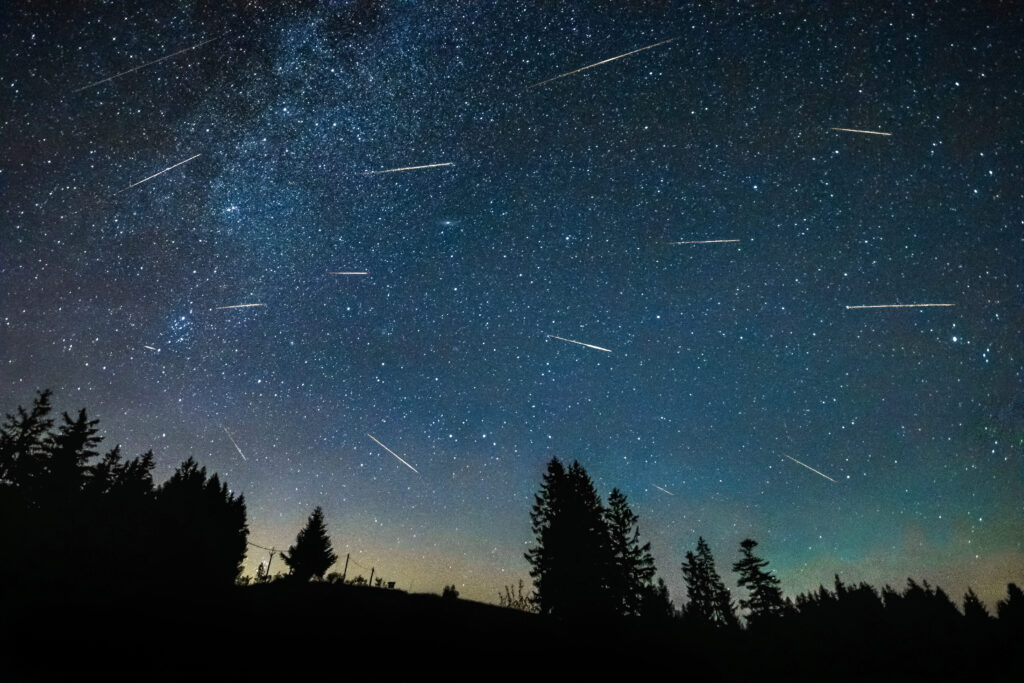
“It’s not the best meteor shower of the year, the Geminids are, but that’s in December, and nobody wants to go outside in December, right? It’s a combination of a good amount of meteors per hour and a good time of year, a good season,” said Hinds. “December is not everybody’s favourite time of the year to go sit outside on a lawn chair.”
Not only that, but the Geminids tend to make for a difficult viewing because of inclement weather at that time of year, especially a higher latitudes in the Northern Hemisphere.
“It’s rarely really good weather, too; you rarely get clear skies in December. Usually it’s cloudy, so it’s it’s a much better chance of having clear skies for the Perseids and and it’s nicer to sit outside late at night in the summer than it is in the winter,” said Hinds.
Originating from the constellation of Perseus, Hinds recommends looking anywhere other than the constellation the meteors originate. Since Perseus is in the North, Hinds recommends people face south while viewing the meteor shower because viewers will be able to see meteors streak across the sky.
Moreover, the moon’s presence in the night sky could complicate things.
“So one of the issues of meteor showers is that it helps to be in a dark sky to see them. Unfortunately, we have the waning gibbous moon up. So, the moon is rising around, depending on where you are, around 10:30 PM. That will be slightly different for you in Fort Frances, because Fort Frances is so far west, but you get the idea,” said Hinds. “When the moon is up, it will be harder to see meteors. There’s a little brief period of time between when the sun sets and when the moon rises, which will be a good time to catch meteors, but the moon could kind of wash out some of the dimmer ones this year.” Adding, “The Perseids are also known for quite bright meteors in some cases. So even if you’re watching all night long, you should be able to see something, even if [the moon] is up.”
Hinds also shared some quick notes about what makes
“Meteor showers come from debris that’s up in space. That’s what we see when we see those shooting stars. It’s debris coming through the atmosphere, and the debris is left behind by comets. This comet is the Swift tunnel comet, and at [one] time, it passed through the Earth’s orbit. So, along the path of the Earth’s orbit, it left all this comet debris behind, which is usually little bits of rock and ice, dust and stuff like that,” said Hinds. Every year, as we pass that same point on our orbit, a cloud of dust and debris left behind by the comet. That’s what leads to us seeing the meteor showers. And that’s why it’s always at the same time every year, it’s always in the same part of the Earth’s orbit.”





