

I’m sitting at a baseball game one night, doing what I’ve always done at a thousand or so ball games, most of them during five seasons as a Montreal baseball writer. I’m keeping score. To my right, there’s an old guy…ok, another old guy, doing the same thing.
So what are the chances you’d find two people filling in a baseball scorecard, play by play, sitting in the same row of seats? In the same ballpark, the same city, the same country?
Does anybody even know what “keeping score” is?
For the record, it requires a scorecard, with blank boxes for every batter’s time at bat. What you do in those little blank boxes is up to you. In the beginning, for me it was simple. Draw a complete “diamond” — like a baseball diamond — if the batter scored a run, or parts of a diamond if he reached base but didn’t score. If he was out, no matter how, an “X” was sufficient.
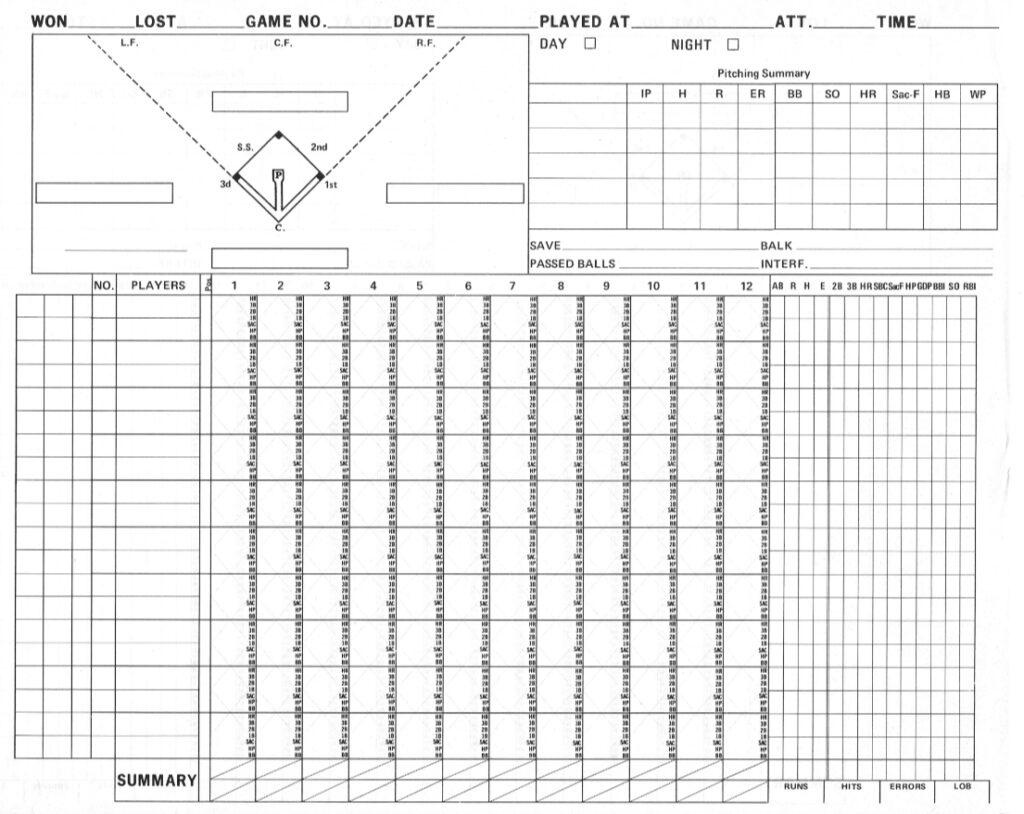
When I started doing this, I was eight or nine. My score-keeping included (with help from my mother) Don Larsen’s perfect game, the only one ever in the World Series, in 1956. It wasn’t my mother who taught me but she knew enough about keeping score to make sure I did it correctly.
Of course, the process evolved. By the time I became a baseball writer, we had large scorebooks supplied by the Montreal Expos, thick enough to last a whole season, all 162 games. Because the pages were large, there was space to include whatever statistics you wanted (this was before WAR, OPS and assorted other foreign statistical acronyms). My enhanced, elaborate diamonds and Xs became the way to re-live what I had seen to write a game story.
Every baseball writer knew how to keep score. It was a prerequisite, a requirement for being an official scorer, which I was for a few seasons, paid $60 a game by Major League Baseball and reviled by players who didn’t agree with official scoring decisions. By my standards, this was a fairly rudimentary way of keeping baseball statistics. The Expos’ first manager, Gene Mauch, was cerebral enough to take it to another level. Mauch not only “kept score” in his head; he once told me how he could look at newspaper boxscores, almost any boxscore, and reconstruct pretty much everything that happened in that game. From looking at a boxscore!
I wasn’t enough of a baseball nerd — despite what you may be thinking — to do that, but I did begin charting balls and strikes before it was popular, and keeping averages when players batted with runners in scoring position (second or third base). Anything I did, and so much more, is now available via the nearest cel phone. Any game, any batter, any pitch — all of it instantly.
“Why do you still do this?” I’ve been asked.
“Because I can…and because I always have.”
It only has to make sense to you…and maybe the old guy to your right. While keeping score is a lost pastime, there’s hope. My curious seven-year-old granddaughter was watching my doodling at one game. Now she wants to know how.
Hey, it’s a start.




