


Seven Generations Education Institute (SGEI) annually hosts an event called Gagwe-gikendamaawiziwin each April. Robert Horton helps put together the event and holds the title “Gaa-aazhide-gikinoo’amaaged,” which means “coordinating Gagwe is a responsibility while also teaching Anishinaabemowin.”
Competitors of Gagwe find themselves competing in five different formats, including storytelling, Jeopardy-style verb conjugation, creating new Anishinaabemowin words, tech-driven art and presentations in Anishinaabemowin to reward and empower learners as well as the community. Sometimes referred to simply as Gagwe, or Quest for Knowledge, the event hosts Anishinaabemowin learners from the Rainy River District School Board, The Northwest Catholic District School Board, and First Nations schools in Northwest Ontario in a fun, creative competition that keeps Anishinaabemowin a living, breathing language. The event finished with a double tiebreaker.
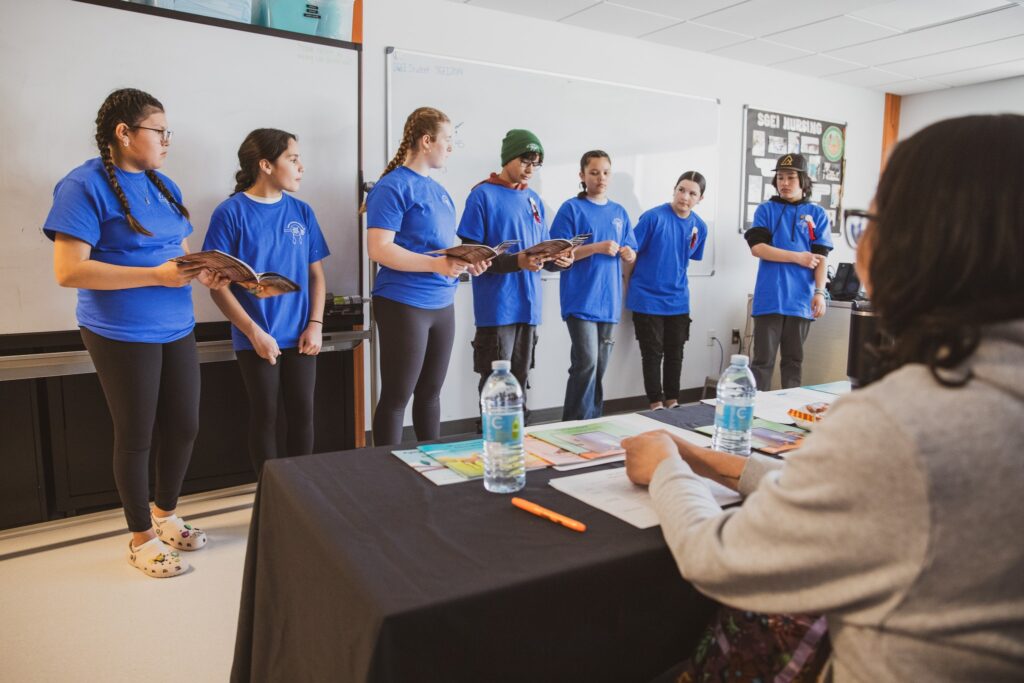
“Every April, we have an annual event called Gagwe-gikendamaawiziwin,” said Horton.
“What that means is trying to attain knowledge. It’s a translation of it, but colloquially, it’s been known as Quest for Knowledge.”
For over 20 years, Gagwe-gikendamaawiziwin has been supporting Anishinaabemowin learners across school district and First Nations boundaries in Northwest Ontario.
“Each school selects teams of roughly eight in two different divisions,” said Horton.
“There are Grades Five and Six in one division, and Seven and Eight in another division. Each school selects learners that are that are really doing well in Anishinaabemowin.”
Once the selected teams and classrooms continue learning Anishinaabemowin, they head down to Seven Generations Education Institute for Gagwe-gikendamaawiziwin for a full day.
“We have a number of competition stations that use things like technology, creativity, fun games and things like that for these students to compete,” said Horton.
“On one hand, it’s rewarding all their hard work. [But] it’s also showcasing it, and it’s also involving area elders. Area elders are folks who are invited to serve as judges.”
This year, Anishinaabemowin learners scored through five different activities.
“This year, the five stations: The first had to do with reading and acting out storytelling,” said Horton.
“That was the first station, and that was a lot of fun. Station number two utilized the Jeopardy format in the conjugation of verbs. Number three was the creation of new words into Anishinaabemowin, things like smart boards, cell phones, AI, and things like that. Our Fourth Station was the creation of an art piece, or something technology-driven, to generate language back to the community. So, there was a choice of what they wanted to do. The fifth station was the creation of a poem, a speech, a presentation, or a song, completely presented in Anishinaabemowin.”
“The reason we do those two last stations I mentioned was because only about eight students from the schools can attend,” Horton continued.
“So, we wanted to involve students who may or may not have had the ability to attend. They’re being supported and encouraged, and acknowledged, even though they didn’t attend personally. A plaque is given to a classroom that places [in first, second or third.]”
What makes this year’s iteration of Gagwe-gikendamaawiziwin unique is the tied scores in both divisions.
“That was the first time we had tied scores in both divisions,” said Horton.
“We had a tie, I would say, probably about five years ago in Manitou Rapids. But this is the first time we have had two divisions tie. So, we went right up to the wire, which was a lot of fun.”
To settle the tie in both divisions, competitors were tasked with the creation of a contemporary concept, notion, or word translated into Anishinaabemowin.
“The one that really kind of captures that concept and idea the closest, they won the tiebreaker,” said Horton.
“Our whole staff pitches in, like a great big team. We have current and recent language learners who help with the stations, and we have elders and first speakers who serve as judges. It’s really well organized, it’s a lot of fun, and people seem to really, really look forward to it. From the acknowledgement of people using that time and energy to learn language, to being creative with it, to bringing in contemporary and traditional methods, to using it in different ways, really, there’s such positivity from it.”
For Horton, Gagwe is about keeping Anishinaabemowin a living, breathing thing.
“If we don’t have words for, you know, SUV or smart board or mechanical pencil, the relevancy to the world we live in, it starts to dwindle. So that’s what we mean by it’s a living language,” said Horton.
“It’s always growing and always adapting and evolving and working with the modern world and meeting halfway between concept and terminology.”





