

Stargazers in Fort Frances and the surrounding area are in for a special treat this month as an annual astronomical event returns to our night skies.
On Tuesday, April 22, 2025, at 10 p.m., the April Lyrid meteor shower will reach peak visibility for viewers in Fort Frances and the surrounding area. Viewable with only the naked eye, Jenna Hinds, Executive Director for the Royal Astronomical Society of Canada, described comets as “dirty snowballs” and gave some tips for viewing. Hinds said the Lyra constellation is colloquially known as the “Tim Horton’s constellation” among Canadian astronomers due to a nearby “donut” galaxy and a “double-double” star alignment.
“So Orion’s just setting after sunset, but 10 o’clock [is an ideal time for viewing,]” said Hinds. “Just as Orion is starting to set, Lyra is starting to rise over on the other horizon. Observing between like 10 o’clock and 11:15 would be a really good time because the moon is not quite up yet.”
While viewing outside of the recommended time frame is possible, Hinds suggested those interested view the shower facing west high in the sky, preferably with trees to the west, behind viewers, to shield from the Moon’s glow.
The Lyrids recur annually in the night sky in mid-to-late-April, offering stargazers both professional and amateur an opportunity to take in one of the universe’s great spectacles.
Hinds explained that the composition of a comet, as well as physics, are what make them visible and lead to meteor showers.
“Meteor showers happen because a comet has passed through Earth’s orbit at some point,” said Hinds.
“So, as a comet passes through Earth’s orbit, it leaves a bunch of stuff behind. Comets are basically just giant dirty snowballs. They have dirt and ice and stuff like that. As they move through the solar system, they release gases, dust, and bits of things out into space. As the earth comes through that path, those little bits that are left behind by the comet streak through the atmosphere and create shooting stars, meteors, what have you.”
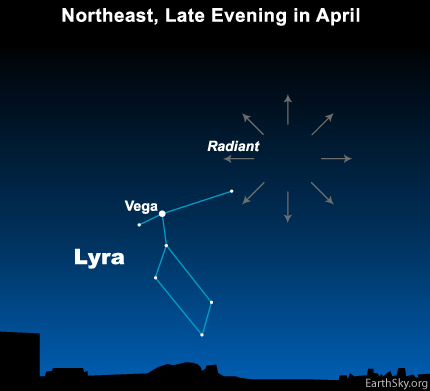
The Lyrids are named after a “prominent” summertime constellation in the Northern Hemisphere, Lyra, which gets its name from the lyre, a historical stringed instrument that originated in the mediterranean.
“The naming of meteor showers comes from the constellation that the meteors appear to come from,” said Hinds.
“These are Lyrids. They come from Lyra. It’s in the Summer Triangle. It’s a very prominent constellation that we see in the summertime. Lyra is actually really fun constellation, and it’s a lyre, it’s a musical instrument. At this time of the year, it’ll be quite close to the Northeastern horizon after sunset. So it’s actually a really good spot for it to be because we can see the meteors coming all the way across the sky, [to the west.]”
Despite the meteor shower carrying the name of the Lyra constellation, Hinds said a common misconception could direct people to the worst spot in the night sky from which to view the event.
“This is sort of something that’s bit of a misconception with with Meteor showers,” she said. “Because there’s a name of a constellation in the name of the meteor shower, and it looks like the meteors are coming from that spot. That’s the worst spot to look. Looking at that constellation is the worst spot because all the meteors are coming away from that constellation.”
According to EarthSky.org, the best way to view the Lyrids is to locate the Lyra constellation and its brightest star, Vega, in the northeastern night sky. Once the star appears, it continues to rise in the night sky and is close to the radiant point for the Lyrids, so the higher the star gets, the more meteors viewers are likely to see.
Hinds compared the Lyrids to the Geminids, suggesting they tend to be relatively lower in frequency compared to the mid-December meteor shower, but not always.
“In the Geminids meteor shower, you see 120 meteors an hour or so. In the Lyrids, you usually only see 10 to 15,” said Hinds.
“But that’s one of the meteor showers that can be kind of unpredictable.”
For those sky watchers with telescopes, Hinds says they can also navigate to a nearby “donut” galaxy and zoom in on nearby constellation points to reveal a “double-double” gathering of stars. Because of this, Hinds said amateur Canadian Astronomers have given the constellation a fitting nickname.
“[Lyra,] it’s kind of a Canadian constellation,” said Hinds.
“A lot of the amateur astronomer community calls it the ‘Tim Hortons’ constellation, colloquially, because each of the stars on the four corners of that parallelogram, each of those stars is a double star. Even though it looks like one star to us, if you use binoculars or a telescope, there are actually two stars there.”
“One corner of it has two double stars. So it’s like a double-double,” Hinds continued.
“At a certain magnification, it looks like two stars. As you zoom in further, each of those two stars has two stars, which is kind of cool. There’s a very easy-to-spot planetary nebula between two corners… [it] looks like a donut. It’s called the Ring Nebula. So, you got a donut, and you got the double-double. So, it’s sort of colloquially known as the as the Tim Hortons Nebula, or as the Tim Hortons constellation.”




