

When it’s your business to help improve herd genetics for cattle farmers across the Rainy River district, well, sometimes your peers and the province make sure you’re recognized for it.
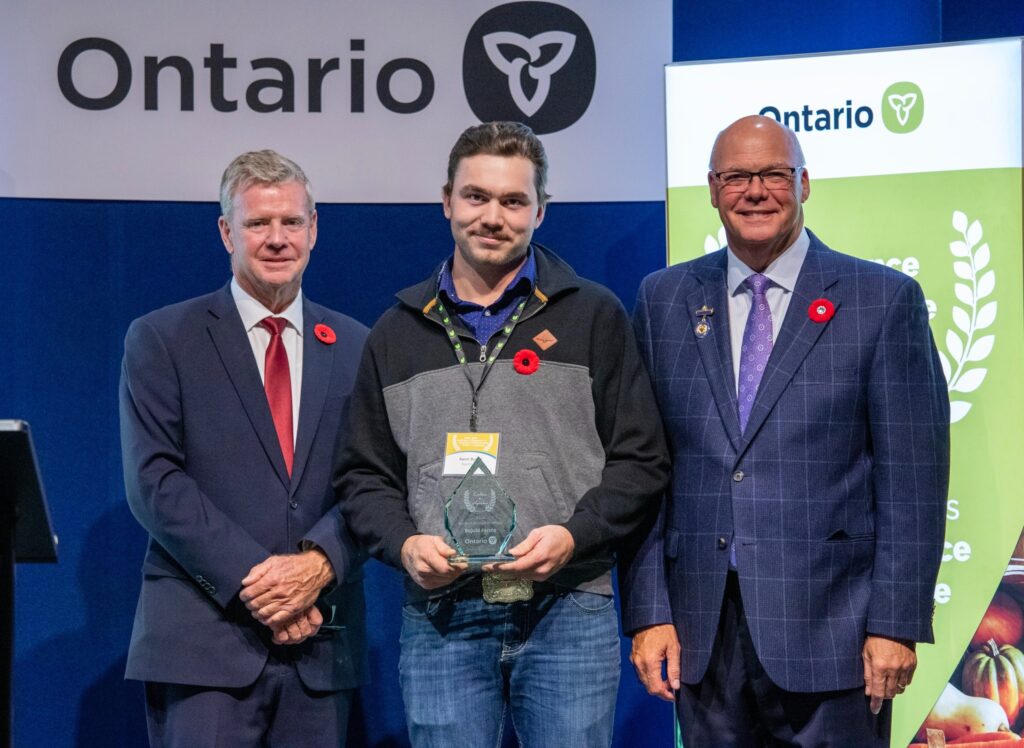
That’s life for Aaron Bujold of Bujold Farms lately. On November 2, 2024, Bujold Farms was awarded the Northern Business Excellence award from the Government of Ontario as part of the 2024 Excellence in Agricultural Awards. For Bujold, who has been working with cattle for years alongside his parents and more recently his girlfriend, it was a big, but welcome, surprise.
“Kim Jo Bliss had nominated us,” Bujold said.
“She wrote a thing on our farm and our business about how we use AI [artificial insemination] and embryo transfer to improve our genetics, but I also AI cows for a bunch of other people in the district to help improve their herds too. So she had nominated us and we were pretty thrilled to win it and receive that award.”
The Excellence in Agriculture Awards are an annual recognition from the Government Ontario that are meant to honour the province’s agri-food leaders.
“The Government of Ontario’s annual Excellence in Agriculture Awards for 2024 is recognizing farmers, processors, industry organizations, and businesses whose contributions are strengthening growth across the province’s $50.7 billion agri-food sector,” the province said in a press release announcing this year’s winners.
“Thirteen winners and 16 honourable mentions in agriculture excellence across 11 diverse categories are being honoured for their efforts this year.”
The Government notes that the Northern Business Excellence award is given to those nominees who demonstrate leadership and excellence and identify how those efforts are supporting the growth and development of Ontario’s agriculture and food sector. The nominees must also be located within what the province calls the “Northern Processor Boundary” which encompasses all of northwestern Ontario and extends to northeastern Ontario and just south of Parry Sound.
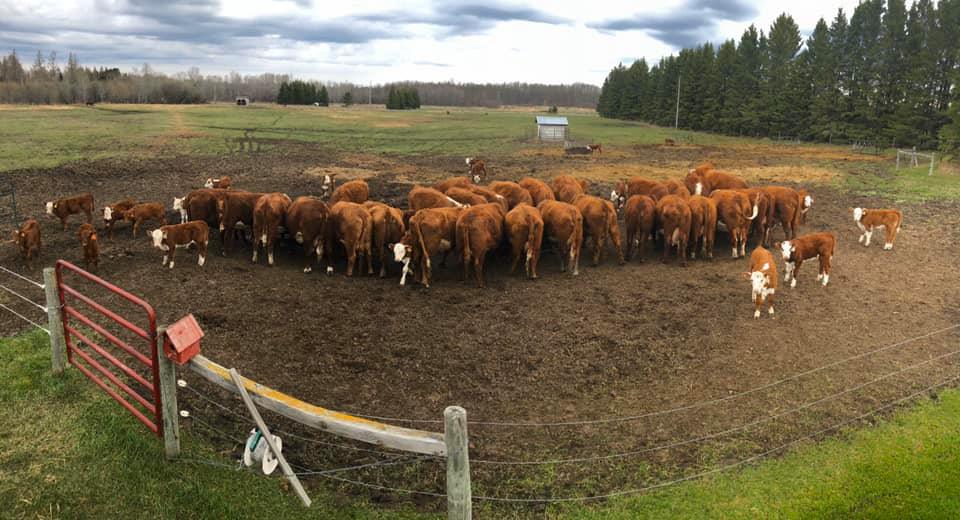
Bujold recalled that his family has been farming Hereford and Red Angus cattle since 1963, but his work with AI didn’t start until he purchased his own purebred cow in 2016.
“I grew up in 4-H with my three brothers, and I was always into the cattle,” he said.
“I love cattle. I like to show cattle. Anything about cattle, really. In 2016, I would have been 16 at the time, and I told him I wanted to get into purebred cattle. So in 2016 we bought our first purebred cow and that’s kind of how we started to get into AI. I started when I was out in school in Western Canada, that’s where I learned how to do artificial insemination myself so that I can do it and we don’t have to bring anybody else in to do it.”
Bujold explained that when it comes to breeding cattle, it’s a timely matter, which makes being able to do the AI himself extra valuable.
“When it’s breeding season, morning and night you’re observing cattle heats,” he said.
“You’ve gotta be there. It’s nice that I can just do it, and if there’s one to do a night or 12 to do a night, I’m there. We started AI-ing purebred cows and that’s kind of how I learned.”
In an industry that is always working to improve the quality of their herds through selective breeding, artificial insemination can be a game changer, especially for smaller farms or those who can’t afford to purchase a high quality animal to integrate into their herd. Bujold said the qualities that farmers might be looking for for their own herd can vary from muscle mass, spine length, better maternal numbers and beyond, and that the AI process can really help to introduce those desired qualities into herds in the Rainy River District.
“The main reason we kind of started to do that is just to bring in better genetics and genetics that are more available,” Bujold said.
“As far as whether we’re using bulls from way down in the States or Canada’s new hottest bulls, it’s easier to find what you want and help that benefit your herd or move your herd forward. So I do all our AI-ing, I think I started AI-ing when I was 19 so I’ve been at it for about four or five years, and then the last three years I’ve kind of opened it up to the community. If other people are interested then I’ve been doing some custom AI work for others so I’ve been going around and helping them source new genetics and genetics that will hopefully move their program forward and make better beef.”
Proud and humbled by the award, Bujold said between cattle shows and regular work he and his family managed to fit a trip down to Toronto into their busy farm schedule, where he was presented his award by Rob Flack, Ontario’s Minister of Agriculture, Food and Agribusiness and John Jordan, Flack’s parliamentary assistant and MPP for Lanark – Frontenac – Kingston.
“I just thought that this doesn’t happen every day,” he said.
“It was good to see. It’s good to see when you go to these events that you’re with other people in the same work. Everybody’s busy, and it’s good to see that everyone kind of takes a few days of a break, and everybody leaves their farm behind us, and we kind of get together and share stories for different practices.”





