



Rebecca Beebe, a teacher at Mine Centre School created a multi-day event to link problem-solving with mathematics and teamwork, together. Moreover, the event combined interactive elements where students cooperated in counting and estimating how many seeds were in the pumpkins, and then calculated the sum of all seeds in the pumpkins.
According to Barbe Dennis, principal of Mine Centre School, the event was put together to help engage students with problem-solving in mathematics.
Dennis said, “[The event is] problem-solving through, like a hands-on activity … instead of just like, ‘Okay, here’s a picture of whatever marbles in the jar. How many do you think there are?'”
“I just wanted to find an engaging way to connect,” said Beebe. “Kids are always hot or excited about Halloween. So, I just want[ed] to find a hands-on, engaging way [that] I could connect Halloween with math.”
According to Beebe, this is relevant to the Ontario curriculum because the students involved were learning about the addition of large numbers.
“Right now, we’re working on counting and figuring out ways to count the large numbers and connecting those, those curriculum connections,” said Beebe. “It’s a great way to engage them.”
Dennis said the event happened over a couple days to help students digest the information.
“It was something that we did over a couple of days, so they had a chance to, like, sort of think about what they had come up with and revised their thinking if they wanted to, which is something else that we really encourage,” said Dennis.
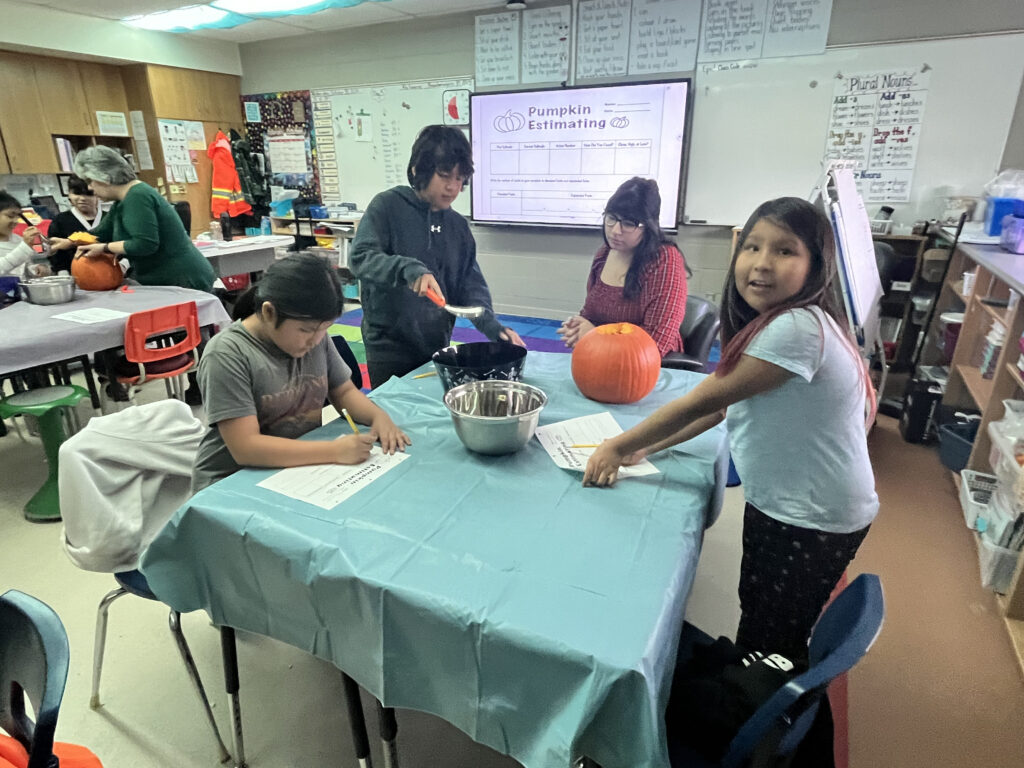
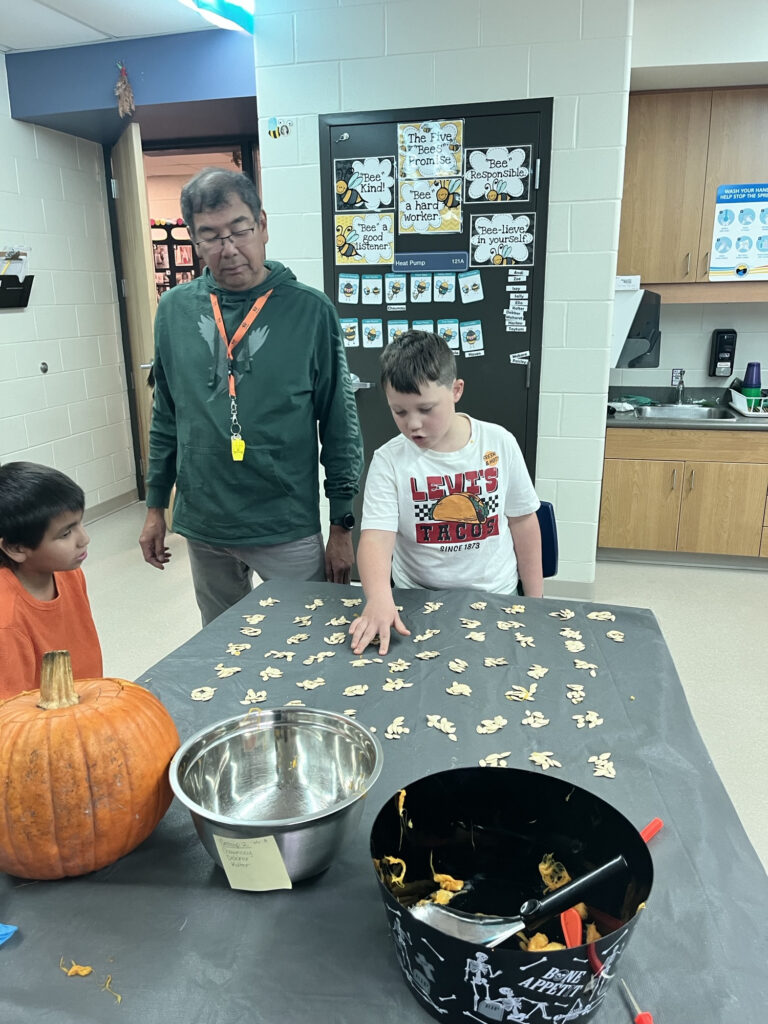
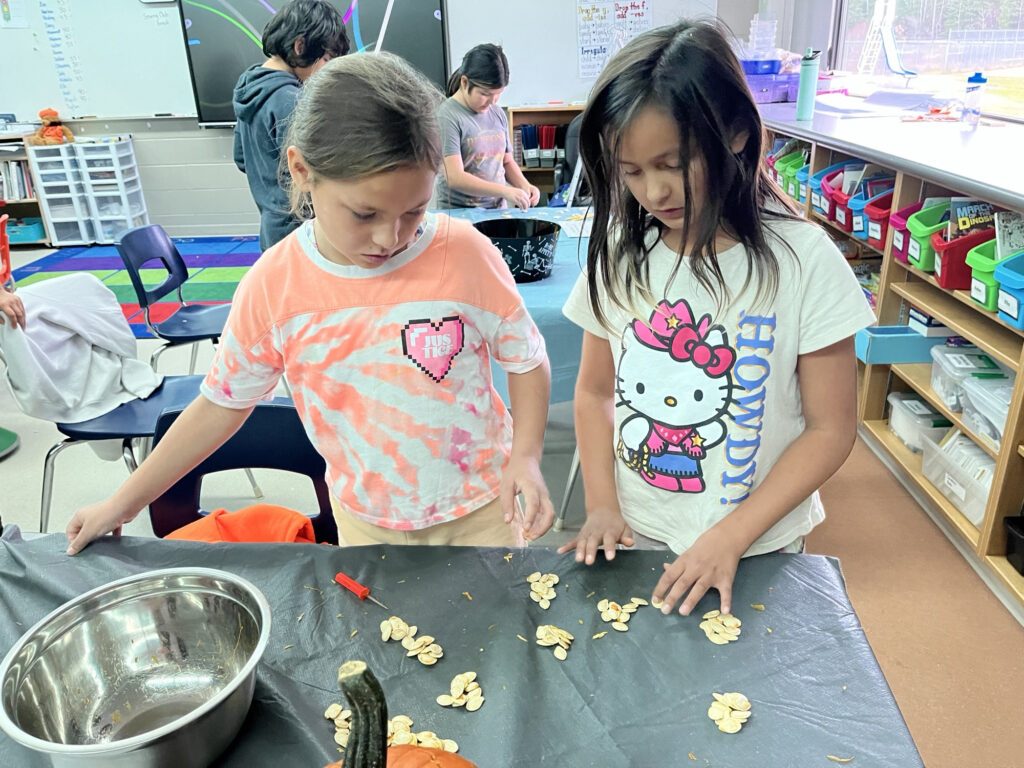
many seeds does a pumpkin hold? By harnessing the excitement of Halloween, the staff
were able to teach some valuable lessons on both teamwork and math.
Submitted photos
Moreover, Beebe thinks this is a way to engage students’ curiosity with a sensory element when using pumpkins because students would manually pull the seeds and innards out of a pumpkin to aid in their estimation.
“There’s a little bit of gross,” said Beebe, “It was just, you know, ‘let’s cut the pumpkin open and let’s look in it with guts and all [then estimate the amount of seeds in a pumpkin.]”
“[Students] give a first estimate, and, you know, then they would clean all the seeds out,” said Beebe.
“[They] could look at them in a bowl,” said Beebe, “Then … they can take a handful [of pumpkin and ponder,] ‘Well … how many seeds do I think there are now?'”
According to Beebe, “[Students] have a chance to revise their thinking based on what they know [after removing the pumpkin’s innards.]”
“We had two groups work together to figure out how many pumpkin seeds were in two pumpkins,” said Beebe, “another two groups to figure out how many pumpkin seeds were in the other two pumpkins, and then we came together and we had a virtual manipulative on the board.”
After using mathematical manipulatives, students returned to class to work together in estimating the total of all seeds.
“Within the next couple days, what we did was … we took the number of seeds from each pumpkin,” said Beebe. “I put all the pumpkin seeds in a bag, and I said, ‘Well, look at this. [This] is all the pumpkin seeds we have, and how many do you think are in here?'”
Beebe did this to give students “hands-on” experience working with some math concepts.
“Basically, [we are] really trying to get some hands-on application for them to be comfortable with counting and place value.”
Beebe thinks the event went well, and thoroughly engaged their curiosity.
“It really engaged their curiosity,” said Beebe. “There were smiles, they were working as teams, [and] there was no arguing. They were all engaged, and they all wanted to see how many pumpkin seeds [there were.]”





