

Conservative Party of Canada leader Pierre Poilievre is hoping a stop in the Rainy River District will turn into more votes for his party come next year’s election, and he is promising bigger paycheques, fewer taxes and less crime to those who help him form the next federal government.
Poilievre held a political rally in Fort Frances on Monday, July 29, 2024. As the daylight turned long down Church Street, hundreds of supporters and those seeking to feel out the Conservative Party of Canada leader filed into the Fort Frances Royal Canadian Legion Branch #29 to hear him speak.
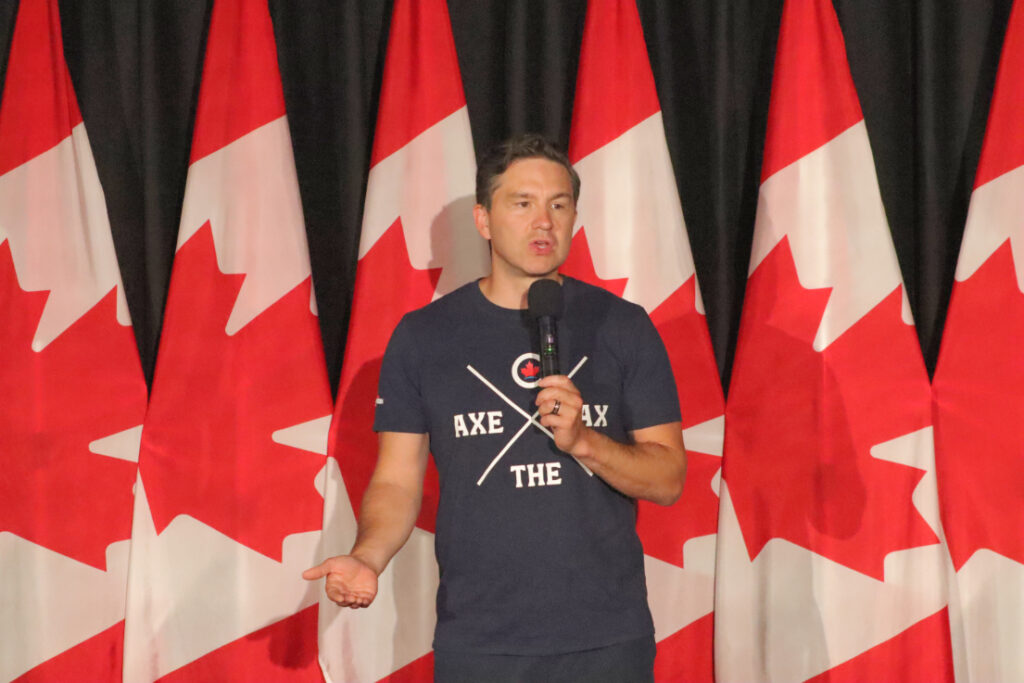
Poilievre was in the Rainy River District earlier this week as part of his “Axe the Tax” tour, a series of stops across northern Ontario to meet with supporters and drum up more support for his party ahead of the next federal election in October 2025, if not sooner. Attendees to the rally were invited to pick up signs sporting several of the slogans and promises Poilievre has been touting over the past few years, including “Axe the Tax,” “Common Sense,” and “Stop the Crime.”
Following an introduction by Kenora MP Eric Melillo, the region’s sole member of the Conservative caucus, Poilievre took to the stage, dressed in a t-shirt that bore another version of his “Axe the Tax” slogan.
Historically, the Rainy River District has been a hard sell for the federal conservatives. The last time a politically conservative candidate was elected in a federal riding that included Fort Frances was when future Conservative Party of Canada leader Robert James Manion won the historic Fort William and Rainy River electoral district in 1917. Manion served as the district’s MP until the riding was redistributed into the Kenora-Rainy River riding ahead of the 1925 federal election.
If the prospect of winning a historically Red/Orange district seemed daunting to Poilievre, he didn’t let it show. Upon taking the stage he launched into his campaign speech, taking aim at the Liberal/NDP alliance that he says is driving all of the average rural Canadian’s problems.
“Trudeau and the NDP want to ban your hunting rifle,” Poilievre said.
“They want to ban the roads. They want to ban your gas and diesel powered car. They want to ban plastic straws. They want to legalize crack cocaine and other hard drugs. So you can snort cocaine as long as you use a paper straw… what a crazy world, right?”
Poilievre’s “Axe the Tax” tour is primarily centred around eliminating the Liberal government’s carbon pricing plan, colloquially known as the carbon tax, which he says would be “priority job number one” upon being elected into office. However, Poilievre also addressed some of the other large concerns he says are facing everyday Canadians, including inflation, the housing shortage, and increased levels of drug use and crime. By combatting these issues, Poilievre told the assembled crowd that he would “restore the country you grew up in.”
“It was a meritocracy, not an aristocracy,” Poilievre said.
“It didn’t matter what your last name was, you got ahead on your own merit. And that’s the country we’re going to restore with this common sense plan.”
Poilievre said the first pillar of his plan, axing the federal carbon tax, would make Canadian businesses more competitive allowing them to hire more workers, allow Canadian farmers to produce more affordable food and create more jobs in the country.
The second pillar of Poilievre’s common sense plan is to tackle inflation in Canada, which he called “a tax on the poorest people” who primarily buy with cash. Poilievre stated that the money supply in Canada has increased over the past four years from $1.8-trillion to $2.5-trillion, which he said is a 40 percent growth, but is only backed by a real output growth of four percent.
“Inflation is a tax,” he said.
“It is the most immoral tax, because there is no vote for which the people can hold the politicians accountable. It is done secretly behind the scenes, supposedly without anyone noticing. And it is a tax on the poorest people who deal most in cash. It is a benefit to the billionaires who receive their wealth inflated as their yachts, their wines, their paintings, their stocks, their precious metals inflated in value, not because they’re producing more, but simply because the monetary inflation pushes them out. So it is a transfer of wealth from the ‘have nots’ to the ‘have yachts.’”
Poilievre said in order to combat inflation, his government would implement a Dollar for Dollar law that would require Ottawa find one dollar in cuts for every one dollar of increased spending, as well as cutting back on money being spend on government consultants, wasteful expenditures, money spent as “foreign aid to dictators, terrorists and multinational bureaucracies” and return that money to everyday Canadians. He also said under his governance as prime minister that he would ensure there is no central bank digital currency.
Poilievre also addressed the state of housing in Canada, noting that at the beginning of Trudeau’s government, the average cost of rent in the country was $950. Poilievre pointed the blame at the bureaucratic red tape that bogs down the time it takes to get new homes built, stating that the costs of associated permits alone add $1.3-million to the cost of every new home in Vancouver, B.C.
“My common sense plan will require municipalities speed up permits, free up land and lower the development charges as a condition of getting their federal billions of dollars of cash,” he said.
“They’ll have to permit 15 percent more homes per year. I will sell off 6,000 federal buildings, thousands of acres of federal land to build, build, build, and we’re going to back up the trades, because we need boots, and not suits, to get things done.”
Poilievre said he would also work with the Red Seal council to put out “more and better” materials into high school curriculums for pre-apprenticeships and work to allow students to begin earning apprentice hours while still in high school. He also said that he would make it so that tradespeople would be allowed to write off the full costs of accommodation, transportation, and food.
The final pillar of the common sense plan Poilievre discussed at Monday night’s rally was to address crime and drug use in Canada, particularly that of repeat offenders getting out on bail and what he stated is the Liberal plan to decriminalize hard drugs.
In January 2023, the B.C. Liberal Government requested a three-year pilot project that would examine decriminalizing small-scale personal possession of hard drugs, measured at or below a 2.5 gram threshold. The federal government granted the exemption and said it would entertain other jurisdictions in Canada to request a similar exemption. The B.C. government requested the federal Liberals re-criminalize hard drugs in public spaces as the province requested it end its pilot project early in late April 2024, citing concerns for public safety. To date, no other requests for similar pilot projects have been approved.
However, Poilievre stated that a plan for national decriminalization had been revealed that would make hard drugs like crack heroin, cocaine and others “more available in your community than a candy bar in a corner store.”
The document in question was revealed to be a packet of briefing materials prepared for federal minister of mental health and addictions Ya’ara Saks, and noted under a heading for “national decriminalization” that the federal government is “committed to working, in partnership, with any jurisdictions that have a comprehensive plan for the decriminalization of possession of small amounts of substances for personal use.”
“Their plan would have to include close oversight and evaluation and ensure enhanced health and social supports, public engagement and law enforcement training,” the packet continues.
“We continue to work with willing jurisdictions to use all tools at our disposal to address this crisis, including approaches to decriminalization.”
Poilievre took aim at pharmaceutical companies who he said were responsible for the opioid crisis, the initial cause of Canada’s drug problem, and the source of funding for his plan to provide increased treatment and recovery services to combat the drug crisis and “bring our loved ones home.”
“Places like the [Bruce] Oake Centre in Winnipeg where they bring people in, detox them, counselling, group therapy, physical exercise, sweat lodges for First Nations, job training, transitional housing to get them back on their feet and start their lives over again,” he said.
“That’s the hopeful future that will break the cycle of addiction and put people back on their feet… We will pay for this by launching an epic lawsuit against the pharmaceutical companies and use their money to pay for the treatment.”
Poilievre ended his speech by painting a picture of what life under his Conservative Government could look like, telling attendees of seniors buying groceries and having money left over, of new fighter jets protecting the country, of small business owners finding security in knowing their “business is viable, his employees are paid, and his family is safe.”
“And now as the lights start to go out, and it starts to get dark, you can hear the sound of children squabbling with their parents, as they want to play one more round of street hockey before bed,” Poilievre said.
“And then finally, quiet, as we see a young couple of sitting on their front porch, soaking in the twilight warmth of another summer night with a Canadian flag gently drifting in the wind at the top of the flagpole on their new home. And as they take back a cold drink, and think of all they’ve accomplished and all that their kids will one day do, they look at each other in the eye and say ‘we’re home.’”
While the rally was well attended, with Poilievre’s Facebook account stating 400 individuals turned out, it was not without some protest. Local 2SLGBTQIA+ advocates Borderland Pride made a post on their Facebook page calling out the Conservative leader and his MP’s for refusing to meet with their communities. In response, Borderland Pride stated they sent an “emissary” to try to meet with Poilievre. In a video accompanying the post, an individual wearing an inflatable unicorn costume is seen on a segway or hoverboard-type device.
The organization notes that Poilievre “didn’t say hello.”






