

If you were to take a magnifying glass to the fabric or Rainy River, it’s likely you’d find Len Ricci’s handprints all across it, and it’s certain you’d find the paper he helmed for more than 40 years documenting it all.
I first encounter Lenard Ricci’s name in speaking with Jack Elliott, a contributor and regular columnist at the Fort Frances Times. I am in Rainy River to do research for our special Rainy River Record edition in recognition of the town’s 120th Anniversary. In searching for story ideas and avenues for research, I am sitting with Jack on the front deck of Woods Quality Bakery. He has generously agreed to lend me some of his time to help me brainstorm, and I’m trying to make the most of it, but my big story idea has run into major roadblocks so far. In the silence of trying to figure out how to track down another lead, Jack asks me a simple question.
“Is anyone writing a story about Len Ricci?”
“No,” I reply. “I can’t say that anyone is.”
“Well, he was the owner of the Rainy River Record for 40 years, right up to when they sold to the Times,” Jack tells me.
After a while in this industry, you learn to recognize a story with potential – “a story with legs,” as my professors would call them – and to not pass them up.
The time between when I tell Jack I’d like to speak with Len Ricci and when we are both sat around a table on a back patio with Ricci and several members of his family and friends, is no more than ten minutes, long enough for Jack to confirm Ricci is up for visitors and for us to make the trip across town.
Ricci is 98 years old, turning 99 this October, and he sits comfortably in the shade of the deck in his chair. It takes Ricci some effort to speak loudly, and his family helps fill out the stories when his voice falters, but his mind is as sharp as it has ever been, and he answers all of my questions as I pose them.
I’m interested in his career as a newspaperman, I tell him, for a story in this special edition. Ricci tells me he was at the helm of the Rainy River Record when it published a special edition of its own for the town’s 75th anniversary in 1979, an edition the family still keeps copies of as a treasured keepsake. His tenure there was “40 some years,” as Ricci tells me.
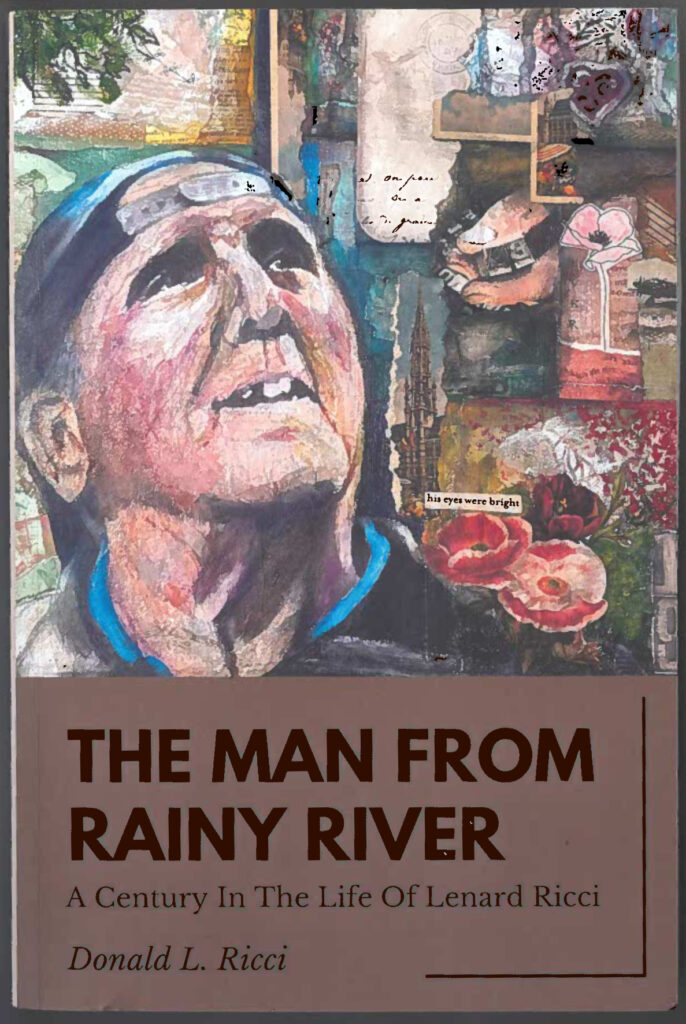
The Rainy River Record was started by Ricci’s grandfather Victor Ricci before passing down to Ricci’s father Art, and eventually to himself. According to “The Man From Rainy River,” a book written by Ricci’s son Donald Ricci, Lenard began working with his father at the Record when he returned from World War 2, where he had served as a rear gunner on a B-24 Liberator.
I aks Ricci about those early days working at the Record, and he tells me about their Linotype machine, a piece of equipment that used molten lead to cast lines of text for use in the printing process, as opposed to earlier typesetting machines where each letter had to be manually placed in the sentence. Maybe thinking the rest of what happened in between wasn’t as interesting, Ricci then tells me about the fire that burned the Record to the ground in May 1970.
“Actually, that was the best thing that ever happened to me,” Ricci says.
“The best thing that ever happened to you?” I repeat, not sure I’m quite understanding.
“Well, then I got into offset,” he replies.
“It goes from actually using ink and paper to digital,” Donald adds, for my benefit.
“The best part was getting into offset, we had hundreds of pictures,” Ricci says, and Donald explains that the offset printing also allowed the Record to print photos from around the community and beyond, and caused the paper’s subscriber numbers to explode.
“When he was able to use local photos, the subscriber base increased,” Ricci’s daughter Marty Sisk explains.
“People wanted to see the paper. He started the Flashback Photo Album, it was extremely popular and made people look forward to the paper. But being able to put in wedding pictures and births and local kids graduating, that made it popular, and he enjoyed that.”
In his book, Donald shares that Ricci’s career working at the Record impacted most of their family, with most of the kids and even grandkids helping out at the paper in one way or another. It also meant that Ricci was also keenly tuned into the community, though he was also community- minded as well.
Ricci shares with me that he was a member of the local Kinsmen organization in Rainy River, and in 14 years, he never missed one of their weekly meetings. With the Kinsmen being a volunteer service organization, there’s no telling how many events he took part in, or how many projects they either assisted with as volunteers or helped raise money for. Ricci’s family tell me that he himself was in the rafters at the arena as it was being built in the early 60s, as well as the Kinsmen being involved in fundraising for the Red Cross Hospital and curling rink. According to records found in Marg Thompson’s “Rainy River: Our Town, Our Lives,” Ricci is listed as one of the Kinsmen’s presidents in 1953-1954.
Donald writes in his book that it was around 1985 when Ricci finally decided it was time to retire from the Rainy River Record, having noticed that printing jobs were drying up as more and more businesses were using their own computer printers for those types of jobs. About the time of his 60th birthday, Donald writes, Ricci sold the Record to the Fort Frances Times – with a stipulation he would continue working for six more months – who continued to operate the Record until its closure in 2016.
Ricci’s time with the Rainy River Record spans 40 busy years, less than half of his incredibly eventful life. My time with him spans less than an hour, but I am struck by his intelligence and sense of humour. His family all remember their life and times in the world of newspaper with pride, and I feel that same pride coming from the man himself as those stories are told. Len Ricci may not have built the town of Rainy River by himself, he is just too young for that, but there can be no doubt he was a key part of its building, and an instrumental part in the documenting of the daily life of Rainy River and its residents.
Put another way, there might well still be a Rainy River today without Len Ricci, but you certainly wouldn’t know the half of it.





