



The number of bluebirds nesting this year has increased from the setbacks of the last three years. The migration of these birds was previously interrupted by freezing rain and late snowstorms. Tree swallows were not affected. Last year there were only five nesting bluebirds. This year, every trail (a line of 10-12 birdhouses) has one or two nesting bluebirds and many swallows, though no count yet.
Bluebirds may have second broods, but not swallows. We monitor the nests and send the data to the Ontario Eastern Bluebird Society. The information consists of how many bluebird pairs are nesting, number of eggs laid, number of nestlings hatched, number of nestlings survived and number that died.
Monitoring is good exercise as you park your vehicle close to Box #1, then walk from box to box while writing down the information required and then walking back the .5 to 1 k.m. While checking the boxes you hope bees aren’t in them, and you fight off mosquitoes – those little creatures which kill more humans in the world than any other predator.
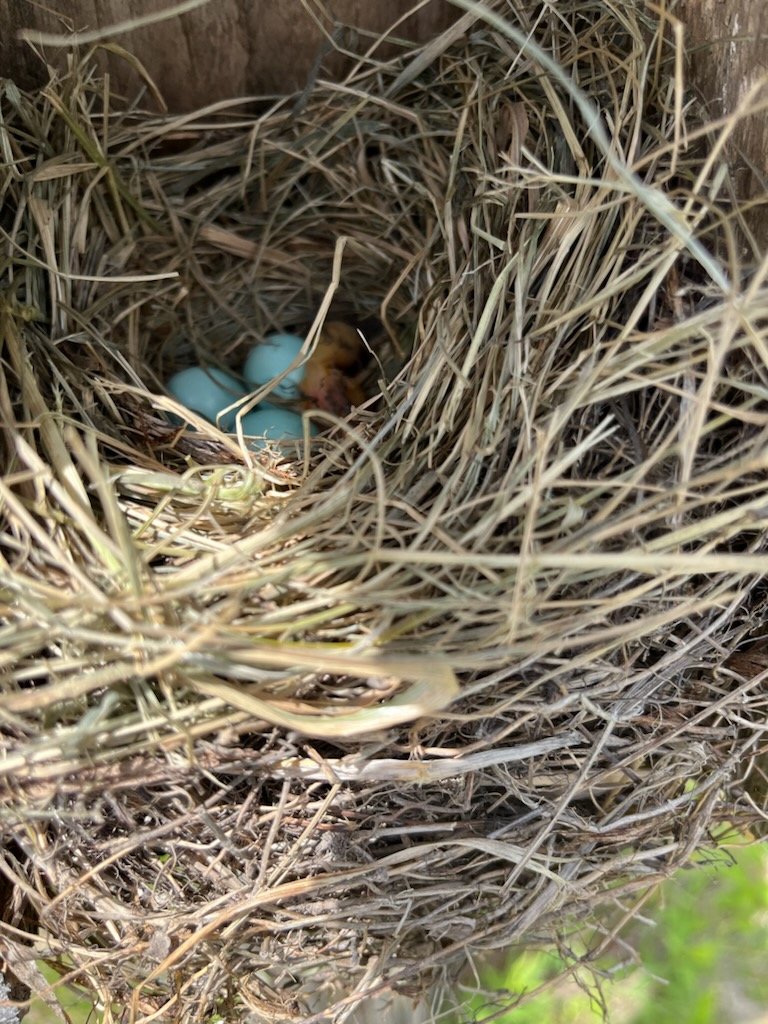
I check the six trails which are situated in Alberton, LaVallee, Devlin and north of Barwick before the birds return each spring. That’s just to make sure they are not occupied by mice or red squirrels.
When the birds have returned, I drive by each trail to find out which boxes are being used. A week later, I begin the real monitoring, noting down which boxes are being used.
In 14-15 days, most of the eggs should be hatched – generally most are. The next monitoring takes place in two weeks as the young are ready to fledge. It’s best to wait a few days more, as the birds don’t all fledge at the same time. If the front of the box is opened when the young aren’t ready to fly, the fledgeling may fall out. Catching them to put them back in is impossible. They will escape and usually die later.
In September, the birdhouses have to be cleaned out. I take time to crush the blowfly pupae which usually spend the winter in the boxes.
This year, Leanne Donaldson, Tom and Shirley Morrish and, as in other years, Bob Saunders, are helping with the monitoring.
I have observed a variety of scenes while monitoring. One this year was very interesting – on the roof of a birdhouse was a groundhog! I suppose it was attempting to make a meal of the eggs inside, but it was having difficulty, as a dozen or so tree swallows were diving at it. Finally, it retreated. Soon, it climbed up again to attempt to get those eggs. Again, the tree swallows dive bombed it, and again, it retreated. I waited a while, but the animal did not return.
I know how the groundhog felt. While checking houses, tree swallows fly at you and just before they touch your head, they make as clicking sound.
This year an incident occurred for the first time in the 32 years that the Sportsmen’s Club has maintained the trails – someone opened the front of all ten boxes in the trail. According to the Bird Migratory Act, that is a crime. One box had a bluebird nest. One nestling was dead, three eggs were rotting and the female had abandoned the nest.
The tree swallows, which hide behind large feathers when nesting, seemed to survive. But I won’t know for sure until my next trip to that trail.



